Black paint tells the truth fast. Under bright sun or parking lot lights, every swirl mark, wash scratch, and patch of haze shows up more clearly than it does on silver, gray, or white. That is exactly why paint correction on black car finishes gets so much attention. When it is done properly, black paint looks incredibly deep and glossy. When it is rushed or handled with the wrong tools, it can look worse than when it started.
Why black paint is the hardest to perfect
Black paint is not necessarily softer on every vehicle, but it is far less forgiving visually. Minor defects that might disappear on a lighter color stay visible on black because the finish reflects light in a way that highlights every inconsistency. Swirls from tunnel washes, towel marring, random isolated scratches, oxidation, and leftover polishing haze all stand out.
That is why correction work on black vehicles requires more than a quick buff. It takes proper washing, decontamination, paint inspection, test spots, pad and polish pairing, controlled machine work, and careful lighting checks. A finish can look great inside a dim garage and then show holograms the moment it rolls into the sun. On black, there is nowhere to hide.
What paint correction on black car paint actually means
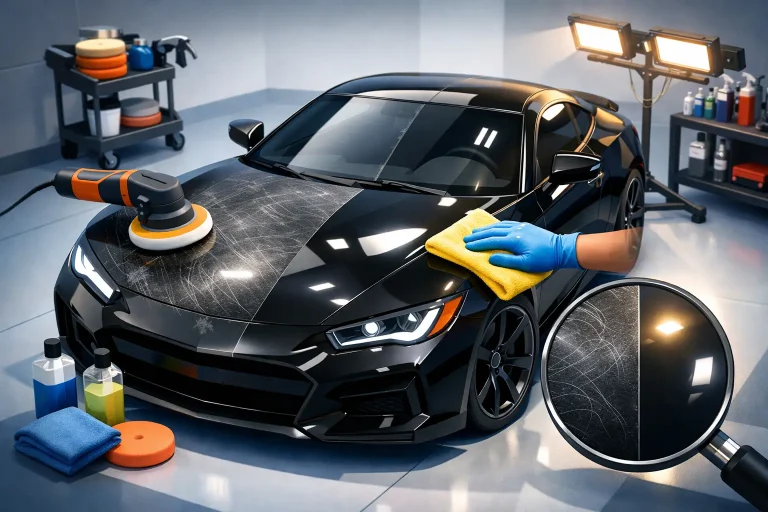
Paint correction is the process of removing or significantly reducing defects in the clear coat through machine polishing. It is not a wax job, and it is not body repair. The goal is to refine the paint surface so it reflects light more evenly.
On a black car, that usually means addressing swirl marks, light to moderate scratches, water spot etching, oxidation, and dullness. Depending on the condition of the vehicle, the process may involve a one-step polish for gloss improvement or a multi-step correction for deeper defect removal and better clarity.
The key point is that correction removes a small amount of clear coat to level defects. Because clear coat is finite, a professional approach matters. Chasing every last mark is not always the right choice, especially on older paint or vehicles that have already been polished multiple times.
Not every black car needs the same level of correction
This is where experience matters. A newer daily driver with wash-induced swirls may respond well to a light polishing step. A neglected vehicle with years of improper washing may need compounding followed by a refining polish. Some defects, including deeper scratches that catch a fingernail, may improve but not disappear completely without compromising paint safety.
A good correction plan starts with inspection, not assumptions. Paint thickness, defect depth, paint hardness, and owner expectations all shape the process.
The process behind a high-quality result
Before any machine polishing starts, the vehicle needs a proper prep stage. That means a thorough wash, chemical and mechanical decontamination if needed, careful drying, and close inspection under strong lighting. If polishing starts on paint that still has bonded contamination, the correction step becomes less effective and more risky.
After prep, the next step is usually a test spot. This is one of the most important parts of the job, especially on black paint. A technician tries a specific pad, machine, and polish combination on a small section to see how the paint responds. The goal is to find the least aggressive method that delivers the best realistic improvement.
Once that system is established, the rest of the vehicle is corrected panel by panel. On black finishes, refining the paint after heavier cutting is often what separates an acceptable result from an exceptional one. Removing defects is only part of the work. The finish also has to be clear, glossy, and free of haze or machine trails.
Lighting changes everything
Black paint should be checked under multiple light sources. Shop lights, handheld inspection lights, and natural sunlight can reveal different issues. This is one reason quality correction work takes time. You are not just polishing. You are verifying.
For customers, this matters because a vehicle that looks good only in one type of light is not truly corrected. The finish should hold up in direct sun, overcast daylight, and evening parking lot lighting.
What kind of results should you expect?
If your black car has typical wash swirls and moderate surface defects, paint correction can create a dramatic visual improvement. Depth, gloss, and clarity all increase when the surface is leveled and refined properly. Reflections look sharper. Metallic flake, if present, becomes more defined. The paint takes on that clean, liquid appearance black vehicles are known for when they are cared for properly.
That said, realistic expectations matter. Not every defect is safely removable. Some scratches are too deep. Some water spots have etched beyond what can be corrected fully without unnecessary clear coat removal. The right goal is not perfection at any cost. It is meaningful improvement with long-term paint preservation in mind.
For many owners, that means aiming for a substantial percentage of defect removal rather than an absolute 100 percent. A professional should be transparent about that from the start.
Why black paint often needs protection right after correction
Once correction work is complete, the paint should be protected. Freshly corrected black paint looks incredible, but it is also freshly exposed in the sense that old waxes, fillers, and contamination have been removed. Without protection, maintaining that finish becomes much harder.
A quality protective layer helps reduce environmental stress, adds slickness, and makes routine washing easier. For owners who want the corrected finish to stay sharper for longer, professional ceramic protection is often the natural next step. It does not make the car scratch-proof, but it can help preserve the look and simplify maintenance when paired with proper wash habits.
This is especially valuable in New England, where road salt, sand, moisture, and seasonal temperature swings can be rough on a vehicle’s exterior. A corrected black car can stay looking far better over time when protection and maintenance are part of the plan.
Common mistakes that make black paint look worse
The biggest problem is aggressive polishing without a plan. More cutting is not always better. On black paint, a heavy compound step can remove defects and still leave behind haze that dulls the final finish if it is not refined properly.
Another issue is relying on fillers. Some products can temporarily mask swirls, making the paint look improved for a short time. Then after a few washes, the defects return because they were hidden, not removed. That may create a quick visual boost, but it is not true correction.
Poor washing after correction is another common failure point. Even excellent correction work can be undone by automatic brushes, dirty wash media, or careless drying. Black paint rewards good maintenance and punishes bad habits quickly.
Is paint correction worth it on a daily-driven black car?
In many cases, yes. Daily drivers often benefit the most because black paint tends to collect visible wash marring over time. If you spend money on the vehicle, care about how it presents, or want to protect resale value, correction can be a smart investment.
The value is not only cosmetic. Corrected paint is easier to maintain visually because the surface is cleaner, clearer, and often protected afterward. For busy owners, that can mean less frustration every time the car is washed or parked in the sun.
Still, it depends on the vehicle and your goals. If the car is nearing the end of its life cycle or the paint has major damage beyond what polishing can safely address, a full correction may not be the right move. But for most well-kept daily drivers, luxury vehicles, and enthusiast-owned cars, the improvement is easy to appreciate.
Choosing the right shop matters more on black paint
Black paint leaves very little margin for error. That is why owners should look for a detailer who can explain the process clearly, set realistic expectations, and show evidence of consistent correction work. Training, certification, insurance, and professional standards all matter here because this is precision work, not a quick add-on service.
A reputable shop should talk you through condition, correction level, timing, and aftercare. They should also be honest about what can and cannot be improved safely. At SPS Auto Detailing, that kind of transparency is part of the service because the goal is not just to make a car look better for pickup day. It is to deliver a finish that holds up and a process customers can trust.
If your black car has lost its clarity, the answer is not to cover it up with more gloss products and hope for the best. The right correction process can bring back the depth that made you love the color in the first place, and it sets the stage for easier, smarter maintenance going forward.